
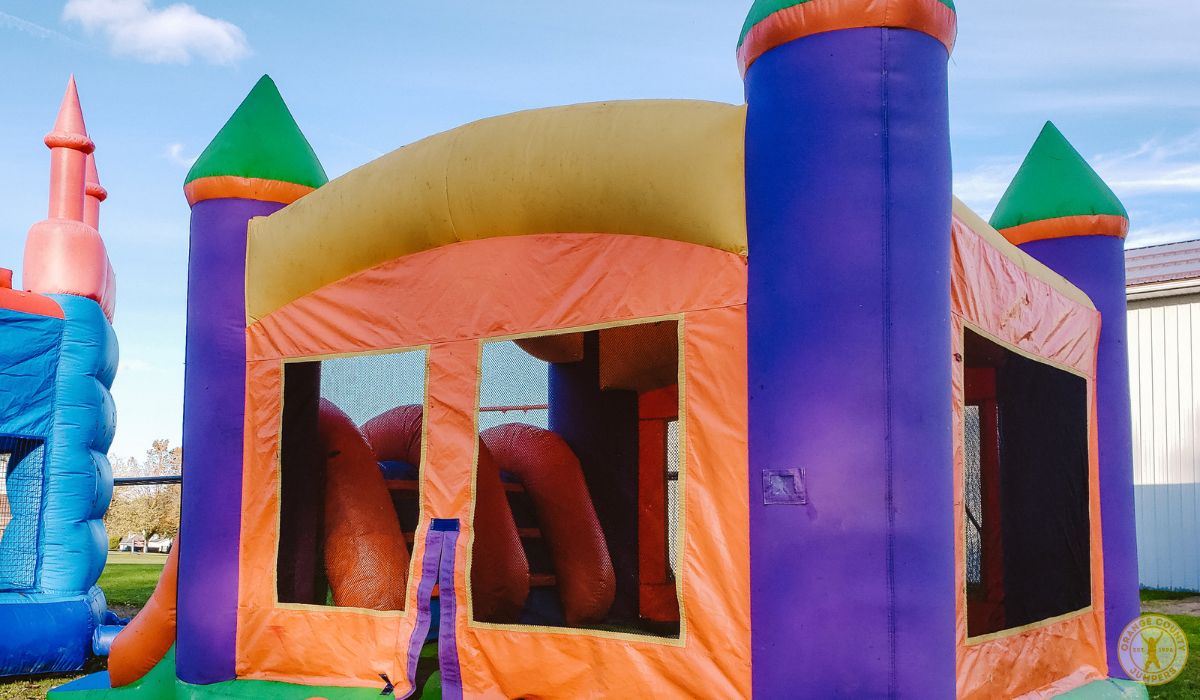
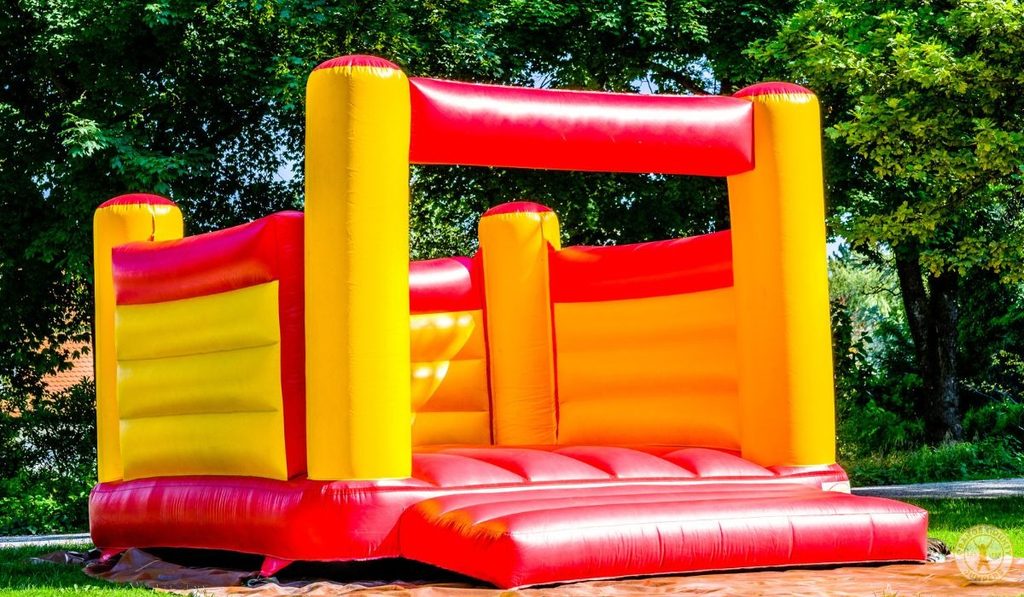
The U.S. Department of Energy points out that a motor’s current draw can triple in the first second of startup. For a typical bounce house blower, that means somewhere between 700 and 1,200 running watts.
But do you know the real party crashers here? That startup surge. From our experience, that surge explains almost every tripped breaker we hear about. So when someone asks how many watts does a bounce house blower use in Orange County, the running number is only half the picture.
We also need to look at your power source. Are you plugging into a standard house outlet, or are you relying on a generator? This guide walks you through both, so your birthday party stays full of laughs, not flickering lights.
We’ve already covered the bounce house weight limit in a previous article, and we’ll take a look at the world’s largest bounce house in our next one. This topic also connects to our post on bounce house facts.
Short Summary
- A typical bounce house blower runs on 800 to 1,500 watts, with startup power spiking two to three times higher for about a second.
- Wattage depends on motor horsepower, not the size of the inflatable, so bigger units don’t always mean bigger power draw.
- A standard 15-amp circuit gives about 1,800 watts, and one blower per circuit keeps things running smoothly.
- Extension cords should be 12-gauge for runs up to 50 feet, and 10-gauge for 50 to 100 feet.
- Blowers are weather-resistant, not waterproof, so a GFCI-protected outdoor outlet is a must.
- Generators should be sized to startup watts, not running watts, with 2,000 to 2,500 watts covering a single blower.
- Never run a gas generator in an enclosed space, and keep a carbon monoxide detector nearby.
How Many Watts Does a Bounce House Blower Use?
So, how many watts does a bounce house blower actually use? The short answer is running watts in the 800 to 1,500 range for most home setups. The longer answer, the one that actually keeps your breaker from tripping, is below.
Running Watts vs. Startup Watts
A standard blower motor runs on 800 to 1,500 watts once it settles into a steady hum. That’s the number printed on the data plate, and it covers how much electricity the unit pulls while it tops off air lost through the seams.
A startup is a different animal. For about a second, the motor can pull two to three times its running wattage just to get the fan spinning. Size your power source for the running number alone, and you’ll trip a breaker before the first guest arrives (ask us how we know).
Here’s a detail folks tend to miss: wattage tracks horsepower, not the size of the inflatable. A big obstacle course with a modest motor can pull less power than a smaller unit running a stronger blower.
Quick-Reference Wattage Chart
This is a sample chart from companies like ours track across their own fleet. Numbers vary slightly by manufacturer, but this covers most standard units on the market today.
| Blower Type | Running Watts | Startup Watts | Approx. Amps |
| Residential, small unit | 800–1,000W | 1,800–2,200W | 7–8.5A |
| Residential, standard unit | 1,000–1,500W | 2,200–3,200W | 8.5–12.5A |
| Commercial, single blower | 1,500–2,000W | 3,200–4,500W | 12.5–16.5A |
| Commercial, dual-blower unit | 2,500–3,000W | Up to 6,000W | 20–25A |
The Fun Starts Here!
Power Needs by Bounce House Size
A small bounce house built for toddlers usually runs on one blower drawing under 1,000 watts. Step up to a medium bounce house, and that single blower typically climbs toward the 1,000 to 1,500 watt range.
Large bounce house units, combo units with a slide, or other larger inflatables often need two blowers instead of one.
This may be surprising, but that doesn’t always mean more total wattage. Some big units run smaller blowers on each side rather than one large motor, which can actually simplify your power requirements.
Quick reality check on inflation: a blower fills most units in three to five minutes, but it doesn’t shut off once inflated. It runs the entire event to stay inflated, replacing air that slowly escapes through the seams. No blower, no bounce house. That’s the long and short of it.
Setting Up Safe Power: Circuits, Outlets, and Extension Cords
Getting power to the blower is only half the job. The other half is making sure that power stays safe and steady for the whole event.
How Many Blowers Can One Circuit Handle?
A standard amp circuit in most homes runs on 15 amps at 120 volts, which works out to 1,800 watts total. Plan around 80 percent of that for anything running continuously, so you’re really working with about 1,440 watts of safe headroom.
One blower on a dedicated circuit is comfortable. Two blowers sharing the same circuit breaker is where people start having a bad afternoon.
We’ve seen it happen at parties: someone plugs a second blower into the same electrical outlets as the first, and thirty minutes in, the whole thing trips.
A dedicated circuit keeps that from happening. It gives the blower its own path back to the electrical box, with nothing else pulling from the same line. Fewer nuisance trips means fewer deflated bounce houses mid-party.
Extension Cord Length and Gauge
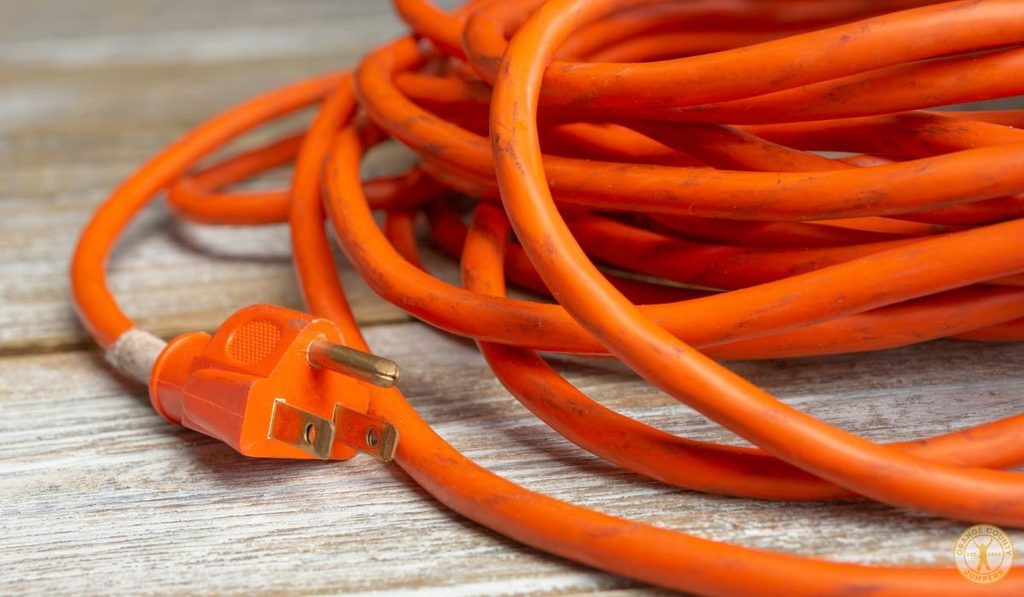
Cord gauge matters more than how many extension cords you own. A thin, cheap cord run 75 feet from the outlet will cause real problems, even on a fresh circuit.
That’s because longer runs mean voltage drop, and voltage drop means the motor works harder to pull the same power. Daisy-chaining two cords together doesn’t fix this. It actually makes the drop worse, since resistance stacks with every connection point.
As a rule of thumb: use a 12-gauge cord for runs up to 50 feet, and step up to a 10-gauge cord for anything between 50 and 100 feet. Past 100 feet, we’d just recommend moving the blower closer to the house.
Are Bounce House Blowers Waterproof?
Short answer: no, not waterproof. Most are weather-resistant at best, built to handle a light drizzle rather than a downpour.
Keep every plug and connection point off wet grass and away from standing water (a puddle under a power strip is asking for trouble). Always plug into a GFCI-protected outdoor outlet. That single habit does more for safety than almost anything else on this list.
No Outlet? How to Size a Generator for Bounce House Power
No outlet nearby? A portable generator solves that, as long as you size it correctly. This part trips people up more than any other step in the process.
Size the generator to startup watts, not running watts. That surge only lasts a second or two, but if your generator power can’t cover it, the unit stalls before the blower even spins up.
For one blower, aim for a size generator in the 2,000 to 2,500 watt range. That covers the startup surge with room to spare. Running two blowers off one unit? Step up to 3,500 to 4,000 watts of continuous power, plus a little extra buffer.
Fuel tank size matters just as much as wattage. A generator with a 1-gallon tank might only run for 90 minutes at moderate load, which won’t cut it for a full afternoon party.
Look for larger fuel tanks if the event runs more than a couple hours, or consider a battery power station instead.
Battery units skip the fuel entirely, run much quieter, and produce zero fumes, which makes them a solid power source for backyards close to neighbors who’d rather not hear generator noise all day.
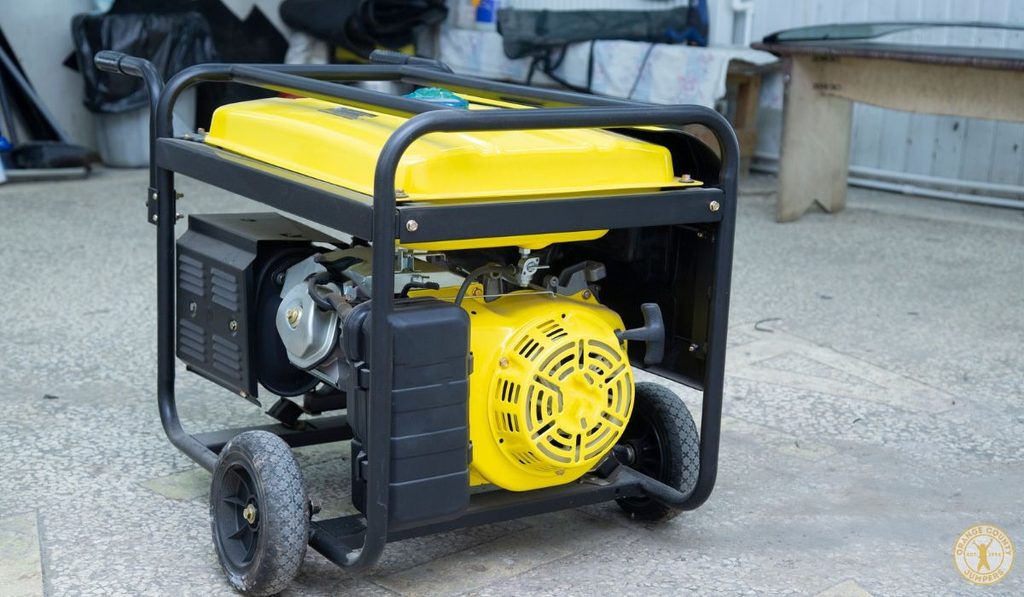
One more thing: never run a gas generator inside a garage or any enclosed space, even partially enclosed. Carbon monoxide builds up fast and it’s invisible. Keep a carbon monoxide detector nearby anytime the generator runs close to a structure.
Final Thoughts
Most blower setups need 800 to 1,500 running watts, with startup power spiking two to three times higher for a second or two. Match your power source to the venue. A house outlet works fine for most backyards, while a generator earns its keep at parks or open fields.
Stick to three habits and you’ll have enough power every time: a GFCI outlet, the right cord gauge, and a generator placed well away from enclosed spaces.
Bounce house rentals through a professional team come pre-matched to the right setup, so guesswork never enters the picture. Planning an event in Orange County? Check out our homepage.