
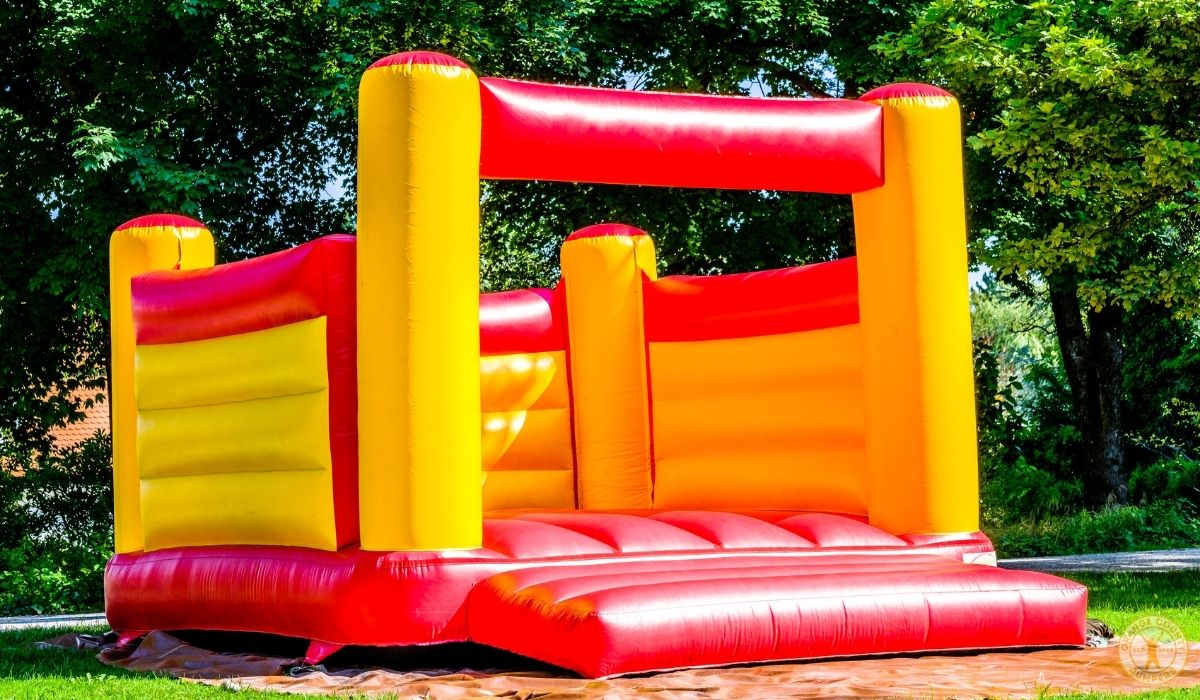

Industrial engineering feels like pure logic. Childhood joy runs on pure chaos. Somehow, they collide inside an inflatable castle.
So, when were bounce houses invented, and who started the whole thing? It was actually an engineer named John Scurlock who invented the first bounce house in 1959.
From our experience, the best stories hide in accidents. When Scurlock’s employees started jumping on industrial inflatable covers (basically roof tarps), a billion-dollar idea was born.
Today, the industry supports 9,849 active party supply rental businesses across the United States.
In this article, readers will discover the surprising roots and how the simple idea grew into the safe modern versions families enjoy now.
Want the material science behind those vinyl walls? Check out what a bounce house is made of from our previous article. Curious about the decade kids went wild for them? When did bounce houses became popular is covered in the next piece.
And for a full timeline with fun stats, our main post, “Bounce House Facts,” has everything you didn’t know you needed.
Short Summary
- John Scurlock invented the first bounce house in 1959 by accident while testing inflatable tennis court covers.
- His wife Frances started the first inflatable rental company in New Orleans in 1968 and grew the idea into birthday parties across the country.
- Son Frank improved safety in 1974 with the Jupiter Jump and later opened the Fun Factory indoor park.
- Modern bounce houses now use heavy duty materials and strict safety rules for safer fun with kids.
John Scurlock and the Accidental Invention of the First Bounce House
John Scurlock didn’t set out to build a children’s toy, the man solved industrial problems. Let’s look at the two pieces that accidentally came together to create the first bounce house.
The Engineering Problem That Started It All
John Scurlock was a structural engineer in Shreveport, Louisiana. His day job? Designing inflatable covers for weather protection.
He created heavy-duty inflatable tennis court tarps that could be blown up with fans, then deflated for storage. Think of giant air mattresses for tennis. These tennis court covers kept courts dry so people could play rain or shine.
Scurlock experimented with different plastic variations (vinyl, nylon blends, reinforced fabrics) to make the original prototypes stronger.
The Moment the Space Pillow Was Born
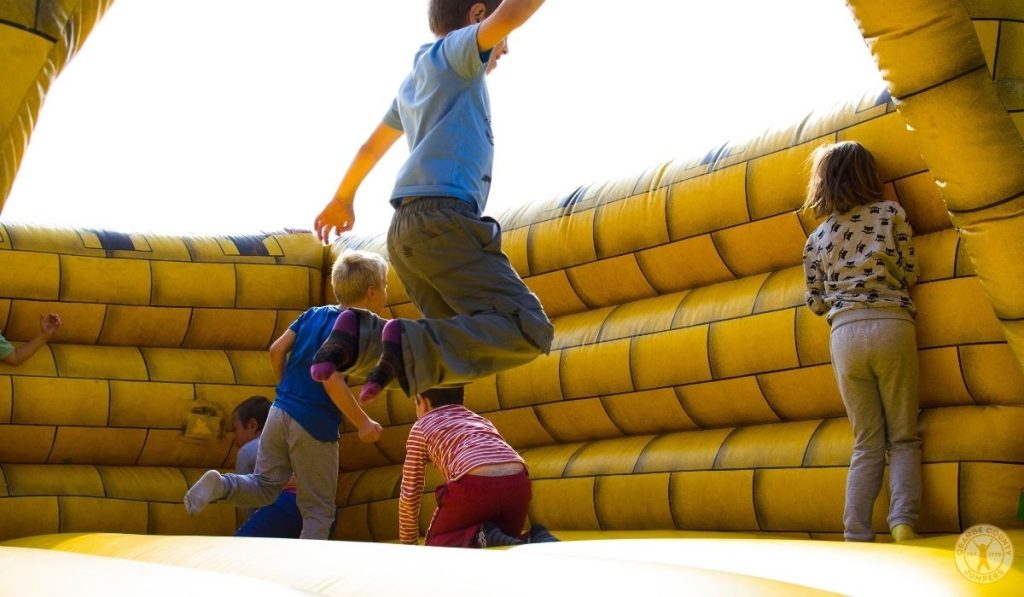
Here’s where the fun started. While Scurlock tested a pressurized inflatable tarp, his employees started jumping on it. Not walking across it, but jumping just for the joy of it.
He noticed the first inflatable wasn’t just a cover. It was a toy waiting to happen. So he built a dedicated bouncing surface: flat, wall-less, and air-filled. He called the prototype the Space Pillow.
It looked like a giant air mattress, with no walls and no roof, just pressurized vinyl. But kids loved the weird bounce.
Scurlock rebranded the experiment into a consumer product. He called it the Space Walk (a wink to his NASA ties). That odd space name stuck for decades.
One quick aside: The Space Pillow had zero safety features.
Key design differences:
- Space Pillow (1959): Flat platform, no walls
- Space Walk (1967): Added pressurized roof, terrible ventilation
- Modern bounce houses: Full enclosures with mesh
The Fun Starts Here!
How Frances Scurlock Launched the First Inflatable Rental Company in 1968
John built the toy. Frances Scurlock built the business. Without her, bounce houses might still be weird NASA rejects. This next part is about smart marketing and a woman who saw dollar signs in jumping kids.

The Woman Who Turned a Prototype Into a Business
Frances watched kids beg to use the Space Walk at family gatherings. She realized families couldn’t afford to buy one outright. But rent one for an afternoon? That worked.
In 1968, she started the first inflatable rental company in New Orleans. A new company called Space Walk ran from a leased warehouse that also sewed horse pads. An odd pairing, sure, but the rental business grew fast.
Frances marketed the inflatable for birthday parties, school fundraisers, and church picnics. She priced rentals low enough for middle-class families. Word spread, and suddenly, every party in Louisiana needed a Space Walk.
Frances turned a weird prototype into t