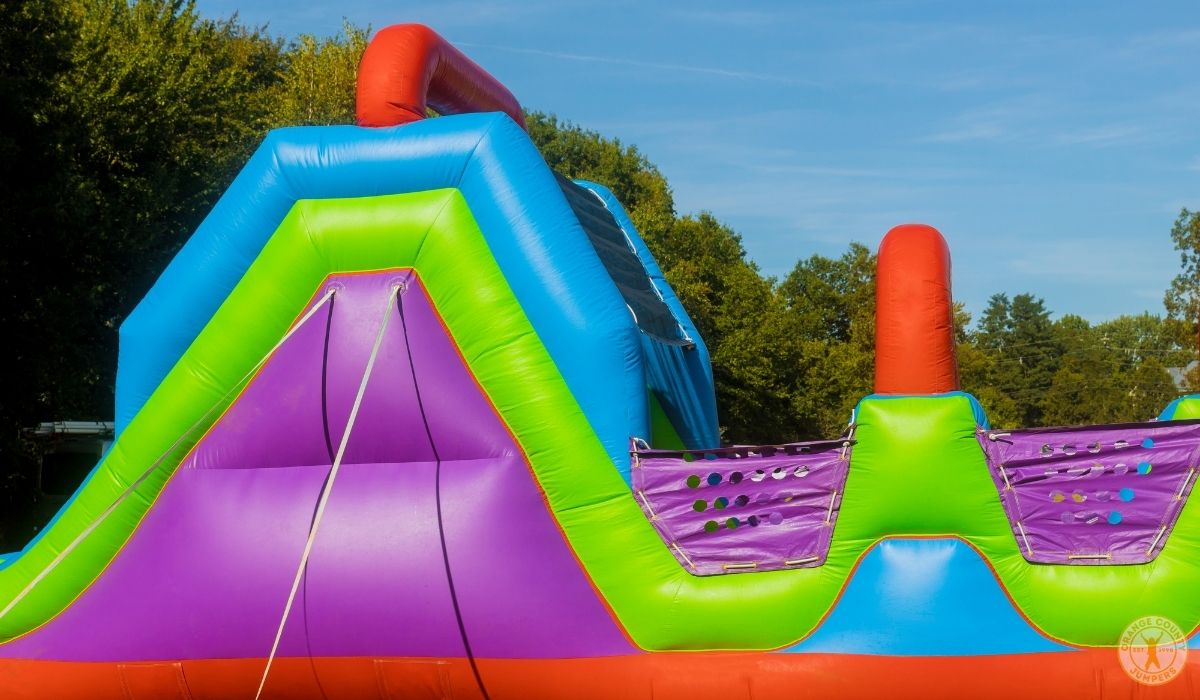

From a $4.2 billion industry in 2024 to a projected $6.2 billion by 2034, the bounce house market shows no signs of deflating.
From our experience, people often ask when did bounce houses become popular, but the real story starts long before the numbers got so big.
We wrote this guide to walk you through the full history of bounce houses, from odd inflatable structure experiments to the fun environment families expect today.
Think of this as your backstage pass to the inflatable business, covering birthday parties, active play, inflatable play, and even the rise of the modern inflatable park.
Curious about the exact year these things first took shape? Check out our post when were bounce houses invented for the deep timeline. Want to settle a friendly debate? We break down moon bounce vs bounce house in our next article.And for a library of quick trivia, visit our main pillar post, Bounce House Facts. Now let’s jump into the surprisingly wild origin story of inflatable bounce houses.
Short Summary
- A guy named John Scurlock made inflatable tennis court covers in 1959. Workers bounced on them for fun. That accident gave us the first bounce house.
- Early units had no walls. Children fell out. So the industry added supported netting walls and fully inflated walls to catch children.
- Bounce house rentals took off in the 1990s. The continuous airflow bounce house made inflatables safer and cheaper for birthday parties.
- Commercial inflatables use commercial-grade vinyl and real safety features. A pogo bounce house from a big box store tears after three parties.
- Modern bounce houses now include obstacle courses, water slides, and indoor parks. Big Bounce America proves how massive this industry got.
- Safety standards like ASTM F2374 and Cal/OSHA rules keep today’s units far safer than the old space pillow designs.
The 1960s Genesis: John Scurlock and the First Inflatable Designs
Ever wonder how a pile of fabric and hot air became a party staple? The answer starts with one curious inventor, a rainy day, and a very happy accident. We’ll walk you through the weird early days of the inflatable device and why nobody saw bounce houses coming.
How John Scurlock Accidentally Created the First Bounce House
Back in 1959, John Scurlock ran a vinyl tarpaulin company in Louisiana. He made inflatable tennis court covers to keep rain off the clay. Pretty boring stuff, right? Then he built a sealed inflatable tennis court prototype (basically a giant air mattress for tennis).
Workers started jumping on the inflatable covers during breaks. They loved it. Scurlock saw the grin on their faces and thought, “Wait, this is way more fun than tennis!”
That moment gave us the first bounce house. Not a grand plan, just a guy who noticed people prefer bouncing to playing fair. (A lesson we still apply when setting up for birthday parties.)
He called his early version an air pillow because that is exactly what it looked like. A big flat pillow of air. No walls, no roof, just a bouncy inflatable structure that made you feel like a kid on a cloud.
The “Space Pillow” and the Early Space Walk Era
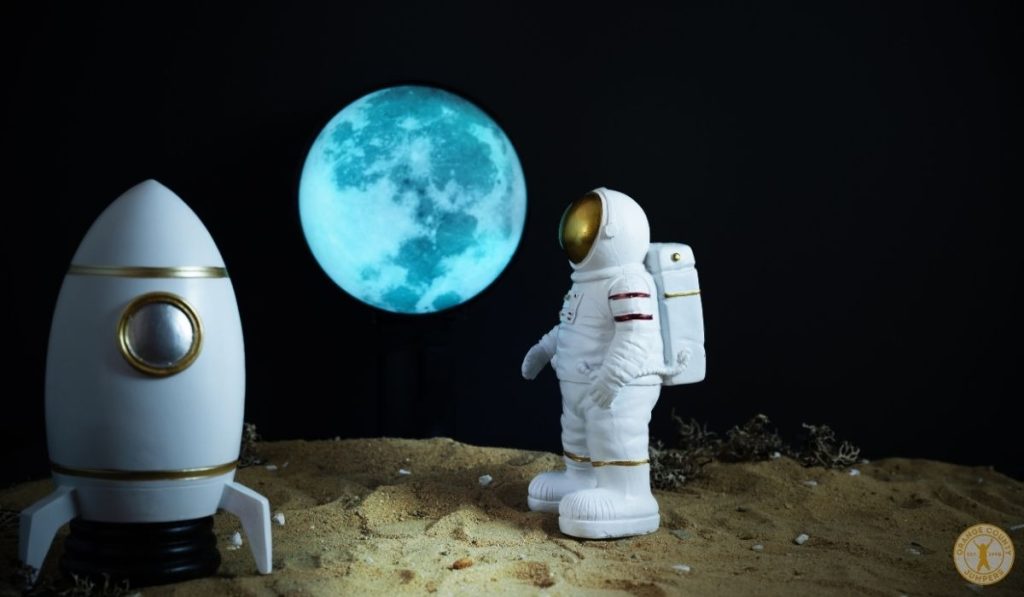
That flat air pillow quickly got a new name: the space pillow. Why? Well, because the 1960s space race made everything space-themed. Scurlock added a canopy and called his creation the space walk.
Later competitors used moon walks. Imagine a first bouncy castle with zero walls. Kids just bounced near the edge. Yikes!
This closed inflatable trampoline (fancy term for a bouncy mat with a roof) looked more like a giant mushroom than a bounce castle. Still, families lined up. They didn’t care about safety yet (spoiler: that changed fast).
The bouncy castle earned other names too: inflatable castles and jumping castles. But none of those early models had netting. A bummer for the kids who rolled off, for sure.
The Fun Starts Here!
Safety Before Entertainment
Here’s the wild part. The original inflatable design was never meant for fun. Scurlock saw it as a safety air cushion for firefighters and NASA.
Jump onto a giant pillow from a burning building? Sure. But then children fell out of early bounce units because there were no fully inflated walls.
That forced real safety features into the industry. Engineers added supported netting walls to catch children mid-flight. Suddenly the catch children function became priority one.
Today, engineering and safety standards trace straight back to those early faceplants. We see the same lessons in every rental we set up. Netting saves teeth. Trust us.
The First Inflatable Rental Company
John’s wife, Frances Scurlock, spotted the real goldmine. In 1968, she launched the first inflatable rental company. She bought a few space walk units and rented them out for backyard parties. That small move created the entire inflatable rental business model we use today.
Think about that. Every rental company that offers bounce house rentals or house rentals for parties owes Frances a thank you. She proved that normal people would rent inflatables for a Saturday afternoon.
Not just fairs or amusement parks, but backyards. Her little experiment turned into a $4 billion industry. Not bad for a side hustle!
When Did Bounce Houses Become Popular? The 1990s Explosion
So when did bounce houses become popular? The 1960s gave us the invention. The 1990s gave us mania. We’ll explain exactly why that decade turned a niche curiosity into a suburban essential.
Why the 1990s Became the Tipping Point
The short answer: affordability and portability. By the 90s, bounce house rentals cost a fraction of what they did in the 70s. A family could rent a unit for $100 for a whole weekend.
Suddenly every church event, school carnival, and suburban birthday party list included a bounce house.
Suburban parents loved the setup. Kids stayed active for hours, and organizers created a controlled fun environment without expensive ride operators.
Some regional companies even branded themselves as a “fun factory” for local events. That marketing worked like crazy.
Even amusement parks added inflatable zones because they saw the demand. Very large events like town festivals started booking ten or more units at once. The tipping point was when a bounce house became cheaper than a clown and less creepy, too.
The Rise of the Continuous Airflow Bounce House
Early bounce houses used a weird bladder system. Air went in, you sealed it, then kids bounced until it went flat (a total buzzkill). Then came the continuous airflow bounce house. A fan runs nonstop.
Holes in the seams let air escape slowly while the fan replaces it. That means zero deflation mid-party.
This new bounce house design allowed for much larger inflatable bouncy houses. We could add inflatable columns, tunnels, and multiple chambers. Inflatable castles grew from tiny pads into sprawling forts.
Commercial inflatables became a real industry because owners no longer had to constantly refill units. The fan does the work, and you just watch the fun!
The Moon Bounce and Jupiter Jump Era
Two brand names dominated the 90s: Moon Bounce and Jupiter Jump. They became household names like Kleenex or Xerox. Parents asked for a “moon bounce” even if the actual brand was different.
Jupiter Jump offered the same thrill: a soft floor, inflatable columns, and netting walls to catch people jumping mid-air.
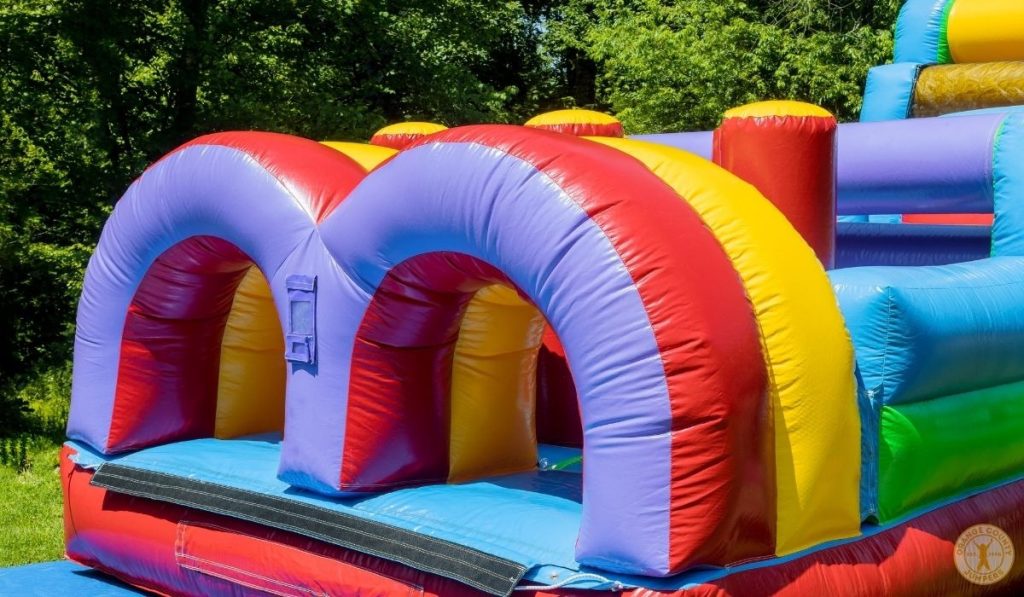
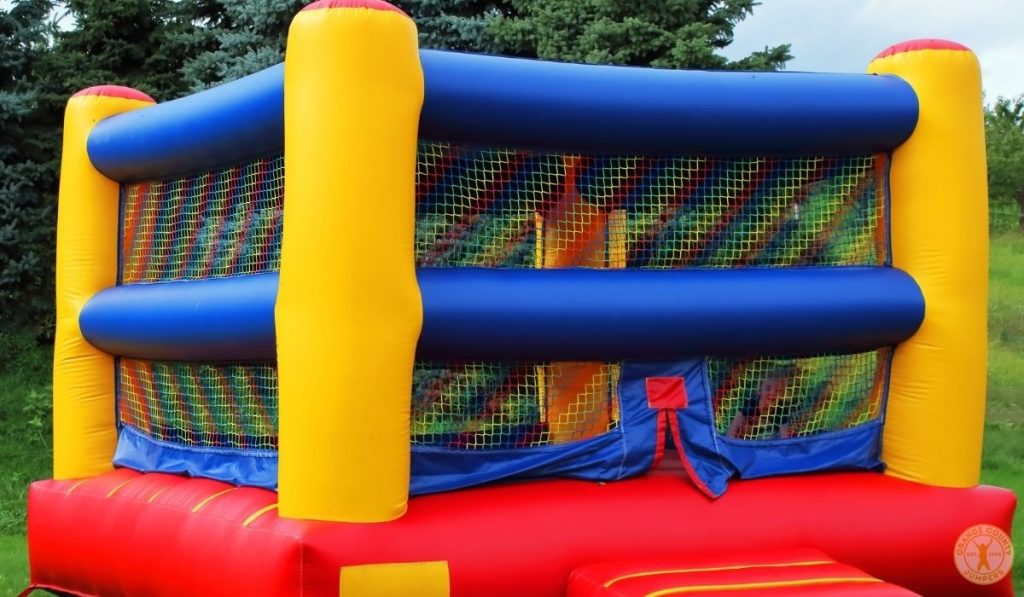
These units gave us the classic jump house or jumpy house shape. A square base, four corner pillars, a roof, and mesh walls. The bounce castle finally had safety.
Kids called it a bounce castle regardless of the theme. We still hear grandmas say, “Where’s the moon bounce?” at parties. That’s brand power.
Making Inflatable Entertainment Affordable
Here’s the real magic of the 1990s. Bounce house rentals became cheap enough for average families. No more needing a rental company that only served amusement parks. Small operators popped up everywhere.
A person with a van, a few units, and a phone book listing could start an inflatable business overnight.
The modern inflatable rental company model lowered costs for schools, churches, and average households. Weekend pricing became manageable, especially for shared neighborhood events.
Today’s inflatable business still depends on that convenience factor. Quick setup, easy transport, and flexible scheduling keep inflatable play accessible for almost any celebration.
Innovation & Expansion: Modern Bounce Houses and Inflatable Parks
The old square bounce house worked fine. But humans get bored fast. So the industry evolved into something almost unrecognizable. Let’s show you how modern bounce houses turned into full-scale attractions.
From Bounce Houses to Full Inflatable Attractions
Why jump in one spot when you can climb, slide, and battle your friends? That question gave us inflatable obstacle courses. We now set up obstacle courses with crawl tunnels, climbing walls, and pop-up punching bags.
Pop-up obstacles appear mid-race (a kid favorite). Interactive inflatable games include jousting arenas and basketball hoops on trampoline floors.
Inflatable slides tower twenty feet high now. Some inflatable domes house entire ball pits inside. One customer asked us, “Can you fit a ball pit inside a castle?” We said yes and watched her kids lose their minds.
The modern inflatable park combines all of these into one sprawling zone. A far cry from John Scurlock’s flat-air pillow.
“Play is our brain’s favorite way of learning.” – Diane Ackerman. She clearly saw a kid on a 20‑foot slide!
The Rise of Indoor Inflatable Parks
Weather is a buzzkill. Rain, heat, and wind are all enemy number one for inflatable play. That’s why inflatable indoor play park concepts exploded after 2010.
The industry shifted indoors after operators noticed strong winter demand. Families wanted reliable active play spaces during hot summers, rainy weekends, and school breaks.
That demand fueled the growth of the inflatable indoor play park model. Brands like Fun Plex expanded the idea with arcades, cafés, and giant inflatable arenas under one roof.
Some venues even introduced an inflatable zoo theme with animal-shaped bounce areas and obstacle runs. Smart move, honestly.
Water Slides and the Modern Inflatable Era
Frank Scurlock (John’s son) took the family business to wetter ground. He invented the aqua tunnel: a sealed inflatable tube you soak with water. That tiny idea became the inflatable water slide we see at every summer pool party.
An inflatable water slide changes everything. Now your inflatable castles can straddle a pool or sit on grass with a constant spray. The inflatable business added a whole new revenue stream (Memorial Day weekend bookings went bonkers).
Commercial inflatables with water features cost more upfront, but they pay for themselves in one hot summer. Our rental calendar proves it.
Big Bounce America and the Modern Scale of Inflatable Entertainment
You haven’t seen scale until you witness Big Bounce America. This traveling road show features the world’s largest inflatable park. We’re talking a 10,000 square foot inflatable dome with a custom soundtrack, DJ, and ball pits the size of studio apartments.
Big Bounce America proves that modern bounce houses can be destination events, not just backyard rentals. Tens of thousands of people attend each tour stop.
The fun environment includes slides, obstacle courses, and even a silent disco inside an inflatable. Our takeaway? The ceiling for inflatable play doesn’t exist. Go big or go home (but go big first).
Engineering and Safety Standards: The 2026 Regulatory Landscape
Fun without rules is just chaos. The industry learned that lesson the hard way. Here’s how safety standards evolved into the strict 2026 requirements we follow every single day.
How Safety Standards Changed the Industry
Remember those early inflatables with no walls? Children fell out constantly, and that forced the first real engineering and safety standards. Manufacturers added fully inflated walls (at least four feet tall) and supported netting walls to catch children who tripped forward.
Netting walls became mandatory after a 1992 incident in New York. A boy bounced out of a moon walk and broke his arm. Lawsuits changed everything.
Today, safety features include double stitching, reinforced seams, and ground stakes rated for 40 mph winds. We test every unit before a rental, no exceptions. (That extra five minutes of setup saves a lot of tears.)
ASTM Compliance and California Regulations in 2026
Here’s the 2026 reality. Amusement ride classification now covers most large inflatables. The gold standard? ASTM F2374. That document dictates everything from fan speed to anchor spacing. Safety standards vary by state, but California goes further.
The North Carolina Department of Labor (fun fact: they pioneered early inflatable rules) inspired Cal/OSHA’s Amusement Ride and Tramway Unit. Safety features must get inspected annually. Local parks require a permit for any inflatable business operating on public land.
We carry our permit binder in every truck. A $5,000 fine isn’t a good party favor.
Commercial vs. Consumer Bounce Houses
Big box stores sell pogo bounce house kits for $200. They look tempting, but we don’t recommend buying them. Commercial inflatables use commercial grade vinyl (21 ounce or thicker). A pogo bounce house uses thin plastic that tears on a twig.
Commercial grade vinyl is typically composed of layered PVC with polyester mesh inside. That inflatable structure weighs 150 pounds and laughs at rough treatment.
Bounce house design for commercial use includes six anchor points minimum. Consumer units maybe have four. The inflatable device you rent from a pro survives 500 parties, and the cheap one survives three. We see the carcasses at landfill drop offs. Buy once, rent smart.
Final Thoughts
The history of bounce houses starts with a simple air pillow. Walls and netting came later. It all started with a dude who noticed people like to jump.
Now look at us. Modern bounce houses stretch into obstacle courses, water slides, and indoor parks. Inflatable bounce houses have their own safety rulebook (finally). That old fun environment got safer without losing the joy.
Active play matters. Safety standards keep it smart. Whether you rent for a backyard or visit a giant inflatable park, the mission stays the same. Let kids bounce and let parents relax.
We’ve been running bounce house rentals for years. We love this weird, wonderful industry. Want to throw a party that actually works? Come see what we offer at Orange County Jumpers. Hop over to our homepage and let us help you plan something memorable!