American families are chasing shared interactive moments, and the numbers prove it. The U.S. entertainment and event production industry now pulls in $648 billion, a figure from Pepperdine Digital Commons.
From our experience, this hunger for real-world fun has turned backyard bounce houses from simple squares into enormous, multi-feature play centers. That’s why picking the right inflatable can make or break a party and also why we created this guide on the types of bounce houses in Orange County.
As a family business in the rental industry, we know how to deliver a fun experience for every crowd. Parents, schools, and corporate teams will find clear answers here.
We break down which inflatable bounce houses suit different age groups, space considerations, and any special event.
We’ve already covered the classic debate in our previous article on moon bounce vs bounce house. For those measuring their yards, our next guide on bounce house sizes will help you choose the perfect fit.
And if you love fun facts, our post on bounce house facts goes deep into engineering and history.
Short Summary
- Turn your backyard into an adventure zone with active bounce house play, lawn games, and creative stations for all kids.
- Keep everyone happy with simple backyard BBQ food, shady spots, and evening touches like an outdoor movie night.
- Smart prep and local Orange County tips make outdoor birthday party planning smooth and low-stress.
- Your own backyard delivers plenty of fun without needing a big venue.
- Mix active, creative, and chill activities for the best birthday party ideas.
Understanding Bounce House Types: A Buyer’s Guide
Most available bounce houses fall into four main architectural categories. Each design serves a specific purpose, from simple jumping to full-blown obstacle courses.
Some models work best for toddlers, while others handle the chaos of older kids. The key is matching the unit to your crowd.
Residential inflatable bounce units use lighter vinyl and thinner stitching, which is something many people miss. They work fine for occasional backyard use. Commercial units, like ours, use durable materials like heavy-duty PVC vinyl with reinforced seams.
These withstand frequent use and hold up to thousands of jumps. The weight difference alone is dramatic. A residential bouncer might weigh 150 pounds. A commercial equivalent often tops 300 pounds. That extra weight means stability and longevity.
The real challenge, however, involves available space. We once delivered a massive combo unit to a backyard that looked spacious on Google Maps. The side yard had a four-foot clearance. The unit needed eight.
The family had to shift everything to the front driveway, which worked out fine, but we lost an hour. So, measure your yard length and width before you call. Check for low-hanging branches.
Note any slopes. Most inflatables need flat, level ground within two degrees of true level. Also consider overhead clearance. Power lines are a dealbreaker.
Different bounce house types suit different numbers of kids. A standard bouncer handles 4 to 8 children comfortably. A large obstacle course can entertain 15 or more simultaneously.
The right bounce house balances the age groups present. (Toddlers in a unit with older kids can get knocked around, even with supervision.) Ask yourself this question: How many kids will actually show up? Then add two more. That’s your real number.
Tip from the pros: Have a backup location ready. Southern California weather shifts fast. The Santa Ana winds can ground any inflatable. A garage or indoor gymnasium serves as a solid alternative.
Want to rent a unit that fits your party perfectly? We can help with that.
The Classic Bounce House and Inflatable Castles
The classic setup remains a favorite because it keeps the focus on simple, active fun. These inflatables work well for smaller gatherings where younger guests need a comfortable play area.
Standard Bouncers and Jumping Castles
Picture a traditional square inflatable castle with four tall walls and a simple open floor. Some call it a bouncy house. Others say “bouncy castle” or “jumping castle.” No matter the name, it’s the most recognized inflatable on the market.
These standard bouncers provide a secure environment for younger kids. The enclosed walls keep toddlers contained. The flat jumping surface prevents awkward landings. We recommend these for ages 3 through 7.
They work great for preschool parties and kindergarten celebrations. What parent hasn’t watched a four-year-old discover the joy of bouncing for the first time? Pure magic.
A standard jumping castle typically supports 4 to 8 children at once. You need enough space in your yard. The footprint usually runs 13 by 13 feet. But remember to add clearance around all sides.
The blower needs room, too. Always check for power lines and other obstacles overhead. Branches, roof eaves, and even treehouses can create hazards.
Ask any rental company about their most common delivery issue. The answer will be “insufficient clearance.” We carry 50-foot extension cords for a reason. Sometimes, the nearest outlet is further than you think.
We also bring sandbags for hard surfaces. Grass is better. (Stakes hold more securely in soil.)
Here’s a good rule: if you can park a compact car in the spot, you have room for a classic bouncer. If not, consider a smaller unit.
As someone once said, “Everything should be made as simple as possible, but not simpler.” The classic bounce house embodies this perfectly. It is simple, effective, and endlessly fun. For many families, that’s exactly what they need.
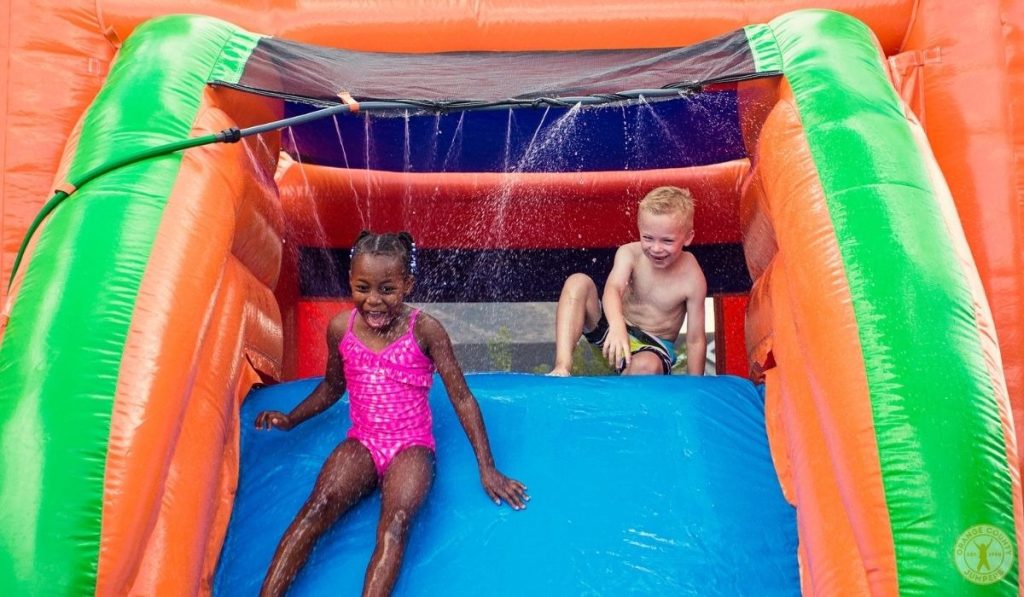
Combo Bounce Houses, Inflatable Slides, and Water Slide Rentals
Some events need more variety, especially when guests include several age groups. Multi-feature units add more ways to play while keeping everyone involved.
Multi-Feature Combos and Climbing Walls
Combo bounce houses combine a jumping area with interactive elements like basketball hoops, climbing walls, and inflatable slides. These jumper combos are popular for a birthday party or family reunions because children can switch activities without leaving the unit.
We often see mixed-age groups enjoy these setups. A seven-year-old might race up the climbing wall, while younger kids stick to the bounce floor (that balance matters during busy parties).
Water Slide Bounce Houses for SoCal Summers
Orange County summers call for something refreshing. Water slide bounce houses add splash pools and landing zones, making them a top pick for hot-weather celebrations.
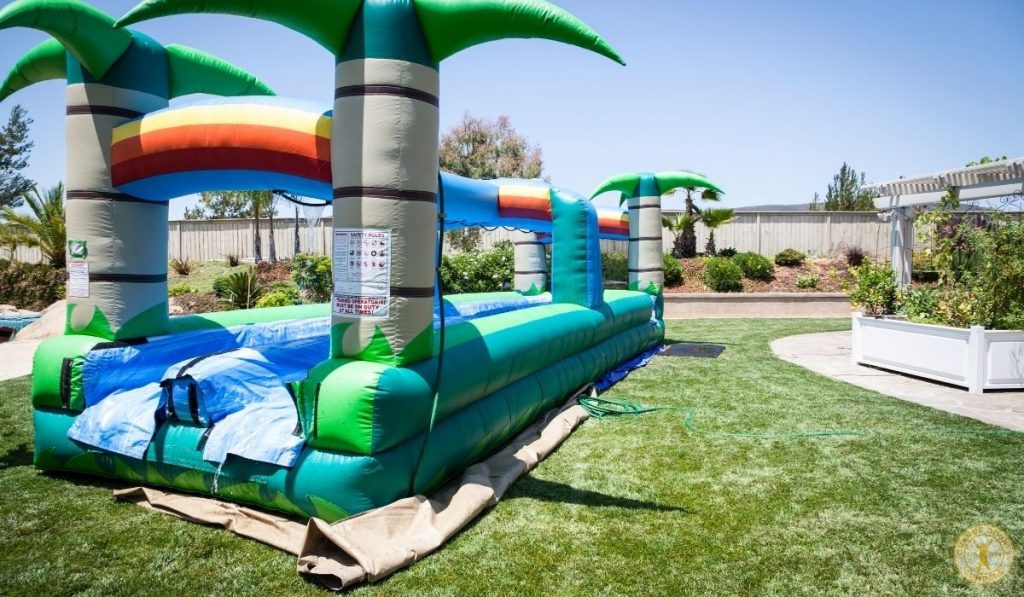
Families planning summer birthdays often choose a water slide with their favorite theme. Themed bounce houses include options like pirates, tropical designs, and sports styles.
These slides deliver thrilling entertainment while helping hosts match their party themes with the overall event vibe.
The Fun Starts Here!
Inflatable Obstacle Courses and Interactive Inflatable Games
These units transform any gathering into an action-packed adventure. Most inflatables offer simple bouncing, but obstacle courses deliver a different kind of thrill. They challenge kids physically and mentally. The competitive element keeps participants engaged longer.
Commercial Obstacle Courses for Large Events
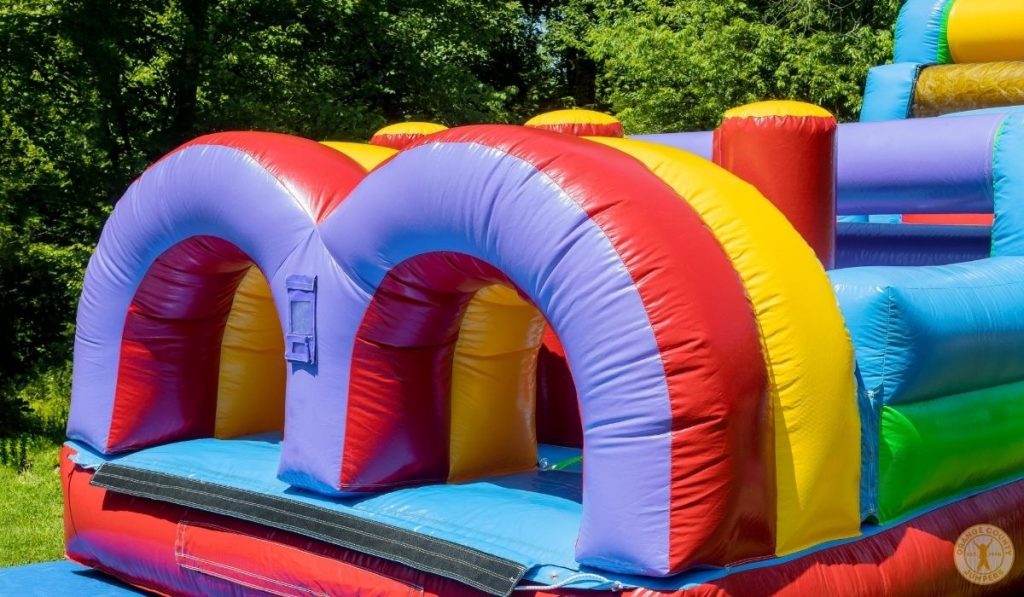
A commercial obstacle course is engineered for endurance and throughput. These inflatable structures feature multi-stage tunnels, climbing walls, slides, and crawl paths.
Some include pop-up hurdles or balance beams. The layout forces participants to navigate a sequence of challenges from start to finish.
What makes them brilliant for big crowds is that with a large obstacle course, wait times are minimized. More participants can be accommodated simultaneously.
Most inflatable obstacle courses also include a timing element. Participants race against each other or the clock. This structure works well for large events like church picnics and family reunions.
Standalone Inflatable Games for Older Kids
Standalone inflatable games offer targeted competitive play for older kids and older children. These aren’t bounce houses.
They are specialized competitive formats like jousting arenas, bungee runs, and boxing rings. A jousting unit features two pedestals with padded weapons. Two contestants knock each other off. The crowd goes wild.
Bungee runs work differently. Participants wear a harness attached to a bungee cord. They sprint to place a marker as far as possible before the cord snaps them back.
This game tests speed, agility, and determination. It appeals to parents who want their teenagers engaged in physical activity. (Teenagers are notoriously hard to impress.)
These inflatable games serve as excellent add-ons to larger event setups. A classic bounce house handles the little ones. An obstacle course entertains the middle group. Standalone games capture the teenagers and adults.
We recently set up a jousting arena alongside a combo unit for a neighborhood block party. The teenagers spent two hours on the jousting arena, barely touching the combo. The neighborhood association booked us again for their next event immediately.
The beauty of such inflatables lies in their specificity. Each game serves a clear purpose. No wasted space, no bored participants. Competitive play creates memorable moments. These games get kids moving. That is half the battle these days.
Space, Safety, and Orange County Park Regulations
Proper planning prevents problems. We’ve learned this through thousands of deliveries. The two biggest questions from customers involve space and safety. Then come the park regulations. Let’s tackle each one clearly.
Measuring Your Space and Understanding Weight Limits
Know your yard’s precise dimensions before calling us. The footprint size must be smaller than your available space. We recommend adding at least three feet of clearance on all sides. This allows for stakes, anchoring lines, and safe entry and exit.
Weight capacities matter more than people realize. Each unit has a maximum load rating. Exceeding this number stresses the seams and the blower. Commercial units can support up to 800 pounds total weight.
That translates to roughly 8 to 10 children depending on their size. These limits are enforced strictly. (A popped seam ruins everyone’s day.)
Safety features are non-negotiable. Adult supervision must be constant and attentive. We provide a safety checklist with every rental. It includes anchoring requirements, weight limits, and deflation protocols during high winds.
An anchor system uses either stakes for grass or sandbags for hard surfaces like asphalt. We carry both options. The wind in Orange County can pick up suddenly, especially near the coast.
We train our team to monitor weather conditions. Safety comes first, after all.
Create a safe environment by removing nearby hazards. Check for tree branches, fences, and outdoor furniture. Look for sprinkler heads that might puncture the vinyl. Inspect the ground for sharp objects.
What Orange County Park Permits Actually Require
Public parks across Orange County enforce strict vendor policies. Each city has different rules. Huntington Beach requires a regional park permit. Irvine demands proof of insurance. Newport Beach needs an approved vendor license. (We maintain all of these.)
The common thread is that you can’t simply show up and set up an inflatable.
Here’s what you can expect. Most parks require a dedicated permit for the rental business to operate. The permit costs vary but typically run between $50 and $200. You must list the rental company by name on the application.
The park checks our license status and insurance certificates. They also verify that our equipment meets commercial safety standards. We provide all this documentation to you before the event. That saves you a headache.
One requirement surprises many people: Park power outlets can’t be used. This rule exists to prevent overloading the park’s electrical system. You need a standalone generator for the blower.
But don’t worry, our generators are quiet and fuel-efficient. We bring them with every park delivery. (The noise level is comparable to a lawnmower at idle.) We also include extension cords and power strips as needed.
Our company remains fully compliant with all Orange County space considerations and regulations. We know which parks allow inflatable bounce houses and which do not. We know the application deadlines. We know the specific spaces that work best for each unit type.
This knowledge saves parents and event planners from last-minute cancellations. Choose a rental company that knows the local landscape.
Final Thoughts
Choosing from different bounce house types comes down to three things. Think about your budget, the exact backyard dimensions, and the ages of the kids who will play. We help families sort this every week.
The right bounce house exists for every kind of gathering. It fits a small birthday party just as well as bigger corporate events and school carnivals. Ready to find the perfect bounce house for your next event?
Explore our safety-certified fleet at Orange County Jumpers. We tailor every rental option to your space, guest count, and fun needs. Stop by our homepage and let’s help you plan something great.