
In 2018, the CPSC found that over 18,000 bounce house injuries sent kids to emergency rooms. That number grabs your attention, but here’s what the data doesn’t show: Most of those injuries were completely preventable.
From our experience, the root cause often comes down to one simple thing: ignoring the bounce house weight limit in Orange County. When families overlook this rule, a fun afternoon can turn into a stressful situation fast.
We wrote this guide to cut through the confusion. You’ll learn exactly how total capacity works, why age matters less than size, and what happens when the air pressure gives out.
Our goal’s simple. We want you to book with confidence and host an event where the biggest worry is which kid gets the next turn.
After you master these weight-limit matters rules, check out our guide on bounce house sizes to pick the perfect unit for your backyard.
Once you book, you might also wonder how many watts a bounce house blower uses for setup. We cover that in our next article.
For a complete safety overview, refer to our post on bounce house facts. These bounce houses are built for joy, not injuries. When you understand the rules, your bounce house rentals keep everyone safe and smiling.
Short Summary
- Know both limits. Every unit has a per person weight cap and a total weight capacity. Exceed either one and the safety fails.
- Match unit size to your crowd. Small units fit 4 to 6 toddlers. Standard 13×15 units hold 6 to 10 kids. Larger units accommodate bigger parties.
- Group by size, not age. A heavy child next to a light child creates a catapult effect. Sort jumpers by weight class for safer bouncing.
- Adults need special units. Standard bounce houses are not rated for adult use. Only units marked for adults should have grown ups inside.
- Stay off rocks and gravel. Sharp surfaces damage vinyl and prevent proper anchoring. Use a tarp or choose grass or turf instead.
- Inspect before every session. Check seams, listen to the blower, and follow the manufacturer’s guidelines. Five minutes of prep prevents problems.
Understand Bounce House Weight Limits and Capacity Basics
Every bounce house we rent comes with two numbers, and they both matter.
The specific weight limit per person tells you the maximum for one jumper. The total weight capacity tells you the combined maximum for everyone inside at once. One is about individual safety, and the other is about structural limits.

Here’s a common example: A unit might allow 150 pounds per person but have a 600-pound total weight capacity. That means four kids at 150 pounds each hit the ceiling. But four kids at 80 pounds each? That’s only 320 pounds. Plenty of room.
Now, keep in mind that the maximum weight isn’t a suggestion. It’s an engineering limit.
How continuous air pressure keeps the bounce area firm
Your bounce house stays up because a blower pushes air in constantly. That continuous air pressure keeps the bounce area taut and springy.
When you exceed the weight limit, the fabric stretches beyond what it was designed to handle. When that happens, the floor starts sagging, the walls lose their shape, and kids trip over soft spots.
The excess weight also makes the blower work harder, and it can overheat. Seams start pulling apart at the stress points.
Units with too many jumpers collapse in slow motion. The air pressure simply cannot keep up with the load.
The Fun Starts Here!
Residential vs. commercial-grade vinyl and reinforced stitching
Residential units use thinner nylon or oxford cloth. They’re fine for occasional backyard use, but commercial-grade inflatables use 18 to 22 ounce PVC vinyl with heat-welded seams.
That material is five times stronger than residential nylon. The reinforced stitching at every stress point keeps the unit from tearing when kids jump hard. Commercial units support 500 to 1,500 pounds total. Residential units top out at 300 to 500 pounds.
That difference determines whether your rental survives the afternoon.
ASTM F2374 safety rating badge as the absolute limit
Look for the badge. ASTM F2374 is the industry standard for commercial inflatable amusement devices. Under this standard, every compliant unit must display a capacity placard near the entrance listing both age class and weight class.
That placard isn’t decorative. It’s the legally operative rating for that unit. If the placard is missing, then the unit is non-compliant.
Match Bounce House Size to Your Guest List and Age Group
Picking the right size starts with knowing who’s jumping. Bounce house sizes vary widely, and each one serves a different crowd.
Small and medium units for toddlers and younger kids
For the littlest jumpers, compact units around 10×10 feet work great. These hold four to six younger kids comfortably. The bounce surface is smaller, which keeps toddlers from bouncing too far apart. We recommend these for first birthdays and preschool parties.
Standard 13×13 to 15×15 party inflatables
These are the workhorses of the rental world. A 13×13 unit comfortably fits six to eight kids. A 15×15 handles eight to ten.
Here’s a real guest list example. Say you have five or six kids averaging 80 pounds each. That’s 400 to 480 pounds total.
A standard bounce house with a 600-pound capacity handles that with room to spare. But throw in two adults at 180 pounds each? Now you’re at 760 pounds and overloaded.
Combo units, slides, and larger units for bigger or mixed events
Combo units with slides have their own math. The slide section typically has a lower weight rating than the bounce area because the load concentrates on a narrower surface during descent.
A typical combo in the 15- to 20-foot range carries 600 to 1,000 pounds total, but manufacturers often specify separate limits for each section.
For bigger parties with mixed ages, go larger. An 18×18 unit holds 10 to 14 kids. A 20×20 handles 14 to 18. These larger units give everyone room to move without crowding.
Quick “how many kids fit” rule of thumb by unit size
Here’s an simple breakdown based on unit size:
- 10×10 to 13×13: 4 to 6 kids. Best for toddlers and small parties.
- 13×13 to 15×15: 6 to 10 kids. The sweet spot for most birthday parties.
- 15×15 to 18×18: 8 to 14 kids. Great for school events and larger gatherings.
- 18×18 and up: 14 to 18 kids. Festival and carnival territory.
Remember, these numbers assume kids of similar size. Mix in older children or adults and the count drops fast. We always tell customers: when in doubt, size up. A little extra room keeps everyone safer and happier.

Manage Mixed Age Groups and Adult Participation Safely
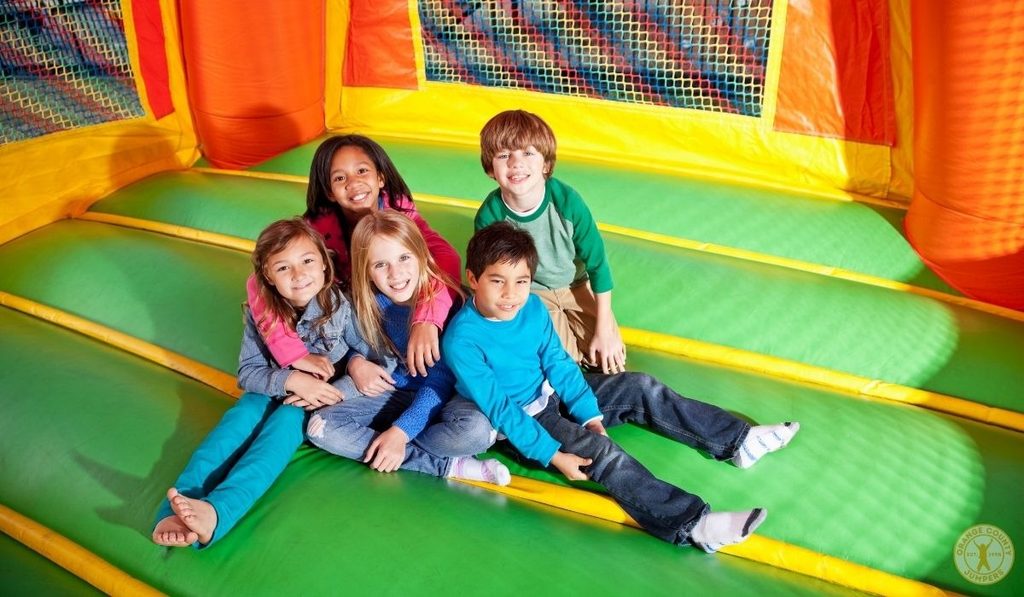
Did you know, most parents assume separating kids by age keeps things safe? That’s not quite right, though. What really matters is size and weight.
Why grouping by size, not age, keeps everyone safer
A tall 10-year-old weighs more than a short 12-year-old. A heavy eight-year-old can easily outweigh a slender nine-year-old. Mixed age groups become safer when we sort by physical size.
We’ve seen parties where a six-year-old weighs 70 pounds and an eight-year-old weighs 50 pounds. Put that six-year-old with older kids, and the smaller child bounces lower. The energy transfers unpredictably. Grouping by weight class solves this problem.
The “catapult effect” and how rough play near heavier jumpers puts smaller kids at risk
Here’s the physics lesson. When a heavier jumper lands, the bounce surface stretches more. That stored energy launches anything nearby.
A 120-pound teenager jumping next to a 45-pound kindergartner creates a catapult. The smaller kid flies higher than expected. Landings become uncontrolled. And there it is, the leading cause of injuries we see with different age groups in the same unit.
Adult use rules and which units are rated for it
Adults ask us this constantly: Can I jump with my kids? Well, it depends on the unit. Standard party bounce houses are rated for children up to 150 pounds. A 180-pound adult exceeds the per-person rating.
Even if the total capacity allows it, the adult’s weight concentrates on a smaller footprint. That foot contact point stretches the vinyl beyond its limit.
Some adult-use units exist. They have thicker vinyl and reinforced stitching throughout the bounce area. These units typically support up to 250 pounds per person and are marked clearly with that rating. If you don’t see the adult rating, then don’t enter.
Rotating age groups to manage the maximum number allowed at once
Here’s a trick: Split your guest list into smaller groups. Let the toddlers jump for 15 minutes. Then cycle in the older kids for their turn. Then the teenagers get their slot.
Keep the total jumpers under the maximum number the unit allows. (That number is printed on the placard near the entrance.) Rotating groups also gives parents a built-in break. Every group gets a fair shot, and nobody gets left out.
Avoid Common Setup Mistakes That Threaten Bounce House Safety
Setup errors undo every other safety measure. We see these common mistakes repeatedly. They are easy to fix.
Overcrowding and exceeding total capacity
The most frequent error, surprisingly, is simple math. People count children but forget the adult who climbs in to take photos.
That adult adds 150 pounds instantly. Suddenly, the bounce house’s capacity is exceeded. A unit rated for eight kids at 60 pounds each has a 480-pound limit. Add one 150-pound parent, and you have room for only five kids. So yes, do the math before the first jumper enters.
Anchoring requirements and ground stability
Wind is the enemy. So, to stay grounded, a unit has to have proper stakes. We use 18-inch steel stakes driven at a 45-degree angle into firm soil. That creates a force that resists wind lift of 50 to 100 pounds per stake.
On concrete or asphalt, we use water bags filled to 40 pounds each. Minimum eight anchors for a 13×13 unit. Twelve anchors for larger units. Skip the cheap plastic stakes. They break.
Pre-event inspection checklist
Every setup should include this quick check. Run your hand along every seam inside and out. Look for any separation in the heat weld. Turn on the blower and listen. If you hear a smooth hum, that’s normal.
But a grinding or rattling noise means something’s wrong. Check the manufacturer’s guidelines for your specific unit. Each model has different inflation times and anchor patterns. And remember, the manufacturer’s guidelines aren’t optional. They’re the law of the unit.
We inspect every seam before the first jumper goes in. We check the blower intake for debris. We verify the outlet is fully secured. These three checks take five minutes and prevent disaster.
Different event types require different inspection frequencies. A birthday party might need one pre-party check, while a multi-hour school carnival needs a mid-event check. Plan accordingly.
Can a Bounce House Go on Rocks?
No. Sharp gravel and rocks damage vinyl immediately. Those tiny pointed stones cut into the bounce surface with every jump. The anchoring also fails because stakes cannot penetrate rock. The unit shifts and moves dangerously.
But there’s a fix, and it’s quite simple. Place a heavy-duty tarp underneath the entire unit. Use one that extends three feet past each side. This protects the vinyl from below.
Or choose a different spot entirely. Grass, turf, and smooth concrete work best. We carry commercial-grade ground cloths for rentals on questionable surfaces. Ask about them when you book.
Final Thoughts
Here’s what we want you to remember. The right bounce house for your event is the one that fits your guest list. Not the biggest unit available, and not the coolest design. The one with a weight capacity that matches your crowd. That single choice is your strongest safety tool.
Follow the guidelines we laid out. Group jumpers by size. Check the ASTM rating. Keep an eye on the total load inside. These steps aren’t complicated. They just require attention.
Make informed decisions before the party starts. Your guests will jump safely. Your families will remember the fun, not the close calls, and that’s what matters most.
Ready to plan your event? Browse our size guide on the Orange County Jumpers homepage, and let’s get your crew ready to jump safely.