
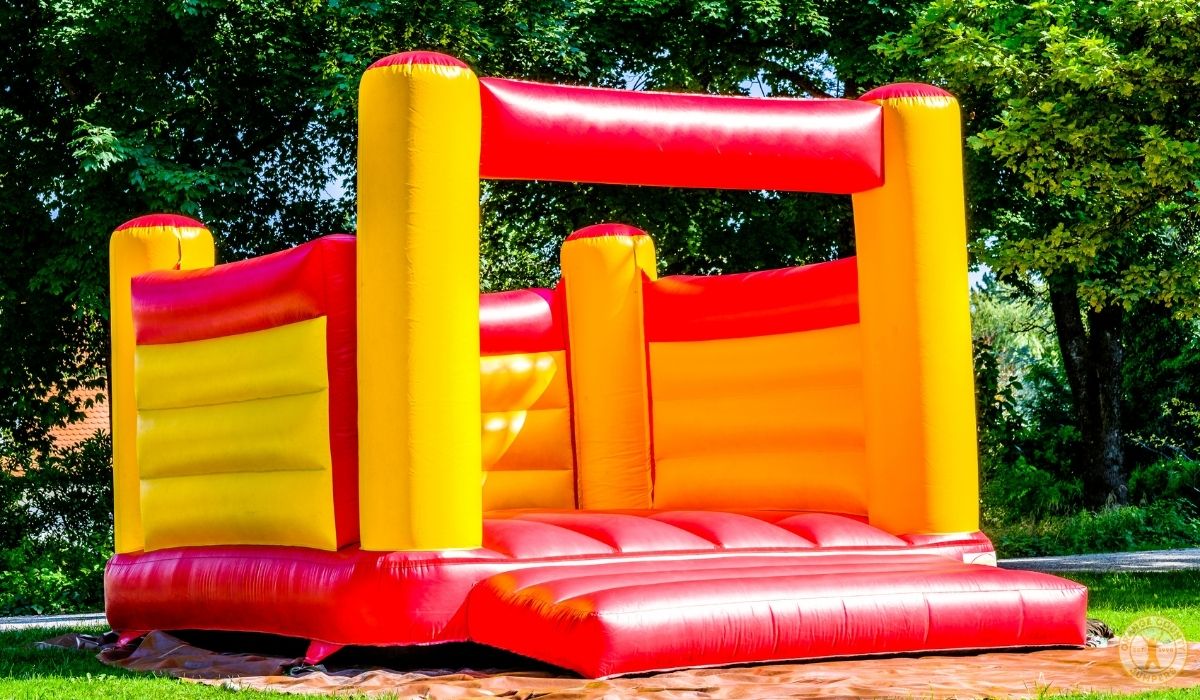

Industrial engineering feels like pure logic. Childhood joy runs on pure chaos. Somehow, they collide inside an inflatable castle.
So, when were bounce houses invented, and who started the whole thing? It was actually an engineer named John Scurlock who invented the first bounce house in 1959.
From our experience, the best stories hide in accidents. When Scurlock’s employees started jumping on industrial inflatable covers (basically roof tarps), a billion-dollar idea was born.
Today, the industry supports 9,849 active party supply rental businesses across the United States.
In this article, readers will discover the surprising roots and how the simple idea grew into the safe modern versions families enjoy now.
Want the material science behind those vinyl walls? Check out what a bounce house is made of from our previous article. Curious about the decade kids went wild for them? When did bounce houses became popular is covered in the next piece.
And for a full timeline with fun stats, our main post, “Bounce House Facts,” has everything you didn’t know you needed.
Short Summary
- John Scurlock invented the first bounce house in 1959 by accident while testing inflatable tennis court covers.
- His wife Frances started the first inflatable rental company in New Orleans in 1968 and grew the idea into birthday parties across the country.
- Son Frank improved safety in 1974 with the Jupiter Jump and later opened the Fun Factory indoor park.
- Modern bounce houses now use heavy duty materials and strict safety rules for safer fun with kids.
John Scurlock and the Accidental Invention of the First Bounce House
John Scurlock didn’t set out to build a children’s toy, the man solved industrial problems. Let’s look at the two pieces that accidentally came together to create the first bounce house.
The Engineering Problem That Started It All
John Scurlock was a structural engineer in Shreveport, Louisiana. His day job? Designing inflatable covers for weather protection.
He created heavy-duty inflatable tennis court tarps that could be blown up with fans, then deflated for storage. Think of giant air mattresses for tennis. These tennis court covers kept courts dry so people could play rain or shine.
Scurlock experimented with different plastic variations (vinyl, nylon blends, reinforced fabrics) to make the original prototypes stronger.
The Moment the Space Pillow Was Born
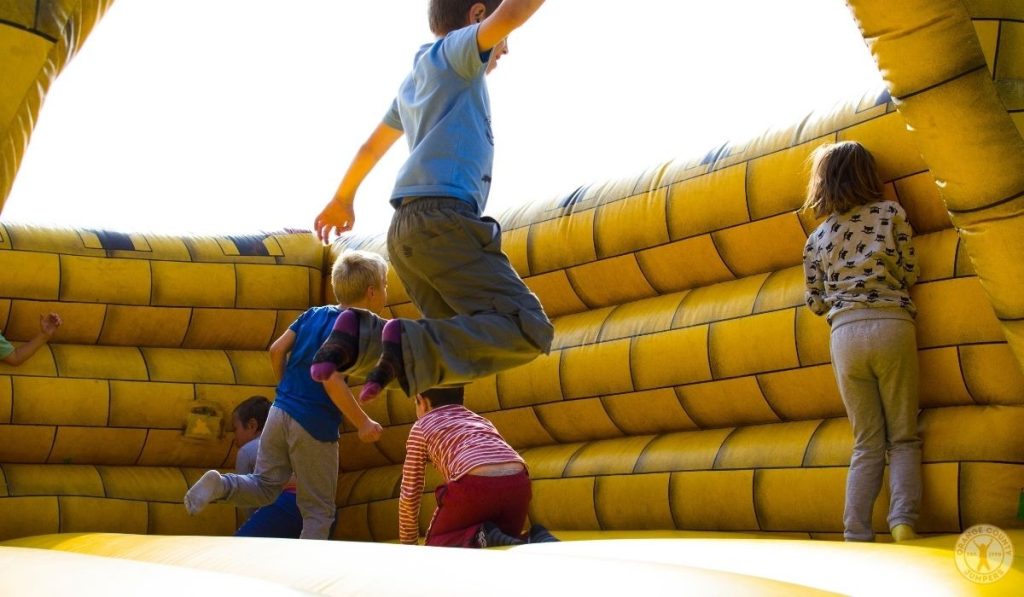
Here’s where the fun started. While Scurlock tested a pressurized inflatable tarp, his employees started jumping on it. Not walking across it, but jumping just for the joy of it.
He noticed the first inflatable wasn’t just a cover. It was a toy waiting to happen. So he built a dedicated bouncing surface: flat, wall-less, and air-filled. He called the prototype the Space Pillow.
It looked like a giant air mattress, with no walls and no roof, just pressurized vinyl. But kids loved the weird bounce.
Scurlock rebranded the experiment into a consumer product. He called it the Space Walk (a wink to his NASA ties). That odd space name stuck for decades.
One quick aside: The Space Pillow had zero safety features.
Key design differences:
- Space Pillow (1959): Flat platform, no walls
- Space Walk (1967): Added pressurized roof, terrible ventilation
- Modern bounce houses: Full enclosures with mesh
The Fun Starts Here!
How Frances Scurlock Launched the First Inflatable Rental Company in 1968
John built the toy. Frances Scurlock built the business. Without her, bounce houses might still be weird NASA rejects. This next part is about smart marketing and a woman who saw dollar signs in jumping kids.

The Woman Who Turned a Prototype Into a Business
Frances watched kids beg to use the Space Walk at family gatherings. She realized families couldn’t afford to buy one outright. But rent one for an afternoon? That worked.
In 1968, she started the first inflatable rental company in New Orleans. A new company called Space Walk ran from a leased warehouse that also sewed horse pads. An odd pairing, sure, but the rental business grew fast.
Frances marketed the inflatable for birthday parties, school fundraisers, and church picnics. She priced rentals low enough for middle-class families. Word spread, and suddenly, every party in Louisiana needed a Space Walk.
Frances turned a weird prototype into the first rental empire.
Sparking a Nationwide Craze
Other event operators saw her success. They copied the model, and a new industry was born.
By the early 1970s, inflatable rental companies popped up from Texas to Florida. Frances proved one thing: parents would pay for controlled chaos. Her New Orleans operation became the first blueprint for modern rental businesses across America.
From Space Pillow to Bouncy Castle: The Safety Revolution
The original Space Pillow was dangerous. No walls meant kids flew off the sides. Also, the enclosed Space Walk trapped heat like a greenhouse. By the 1990s, injuries had piled up. The industry needed a major rethink.
The Early Design Flaws
Early inflatable bounce structures lacked side walls. Kids tumbled off onto hard ground. Meanwhile, the enclosed versions that added walls had a new problem: zero airflow. On a sunny day, the inside hit 120°F. Imagine a pressurized greenhouse with screaming children.
From 1990 to 2010, an estimated 65,000 children landed in ERs from bounce house injuries. Most common injuries: fractures (28%) and strains (27%). These weren’t minor bumps.
The data made one thing clear: the original bouncy houses needed a serious safety upgrade.
Frank Scurlock and the Jupiter Jump (1974)
John and Frances’s son, Frank Scurlock, took over product development. In 1974, he launched the Jupiter Jump. This redesign saved the industry.
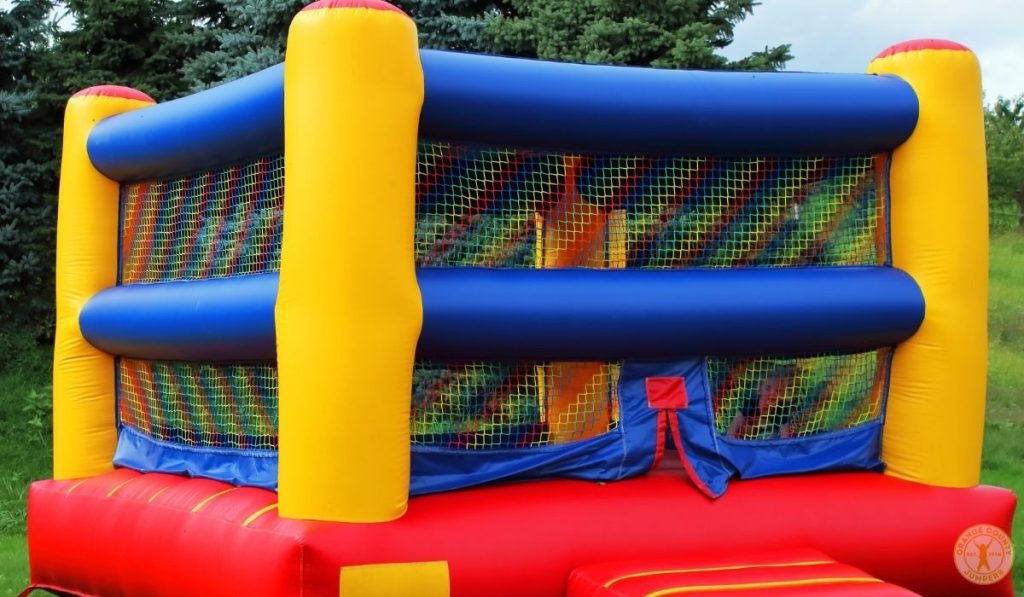
The Jupiter Jump added inflatable columns around the perimeter. Between those columns, Frank installed mesh safety air cushion netting walls. The mesh allowed hot air to escape while keeping jumpers contained.
By 1975, the first true bouncy castle appeared in the Neiman Marcus Christmas catalog. They called it a moon walk (that name still sticks in some regions). The catalog listing featured an enclosed castle with turrets and mesh windows.
And the price tag? Way more than a rental, but the cultural message was clear: inflatables had arrived.
John’s son Frank continued refining the designs. Modern inflatable castles still use his core innovations: air circulation mesh, secured structures, and safe kids’ entry points.
Modern safety features from the Jupiter Jump:
- Inflatable corner columns for stability
- Mesh walls for airflow and visibility
- Rounded edges (no hard surfaces)
- Staked anchor points (added in the 1980s)
The 1990s Boom: Obstacle Courses, Water Slides, and Indoor Parks
The classic castle shape ruled for twenty years. Then the 1990s arrived with a big question: can we jump through something instead of just inside it? The answer changed birthday parties forever.
Frank Scurlock Takes It Indoors (1986)
Here’s a twist most people miss. Frank Scurlock opened the Fun Factory in 1986. That’s before the 1990s boom. Why does that matter? Because he proved inflatable play works year-round.
The Fun Factory was a warehouse packed with bounce houses, ball pits, and basic slides. No more waiting for sunny Saturdays. Kids could jump in February rain. Parents loved the predictability (and the air conditioning).
The Inflatable Innovation Explosion of the 1990s
The decade went wild. Large inflatable designs appeared everywhere, and inflatable obstacle courses became a staple. Kids crawled through tunnels, climbed walls, then slid down. One wrong step meant starting over. Chaotic? Yes. Addictive? Absolutely.
Slides grew taller. The first inflatable water slide launched in the early 1990s. A vinyl ramp with constant water flow. Suddenly, water slide rentals outsold castles every July. Inflatable water parks popped up in backyards nationwide.
Inflatable games like jousting pods and basketball hoops turned passive jumping into competition. A parent once asked us, “Which one do kids love most?” The answer: the obstacle courses never lose their popularity. They’ve become the new standard for fun.
Why the 1990s changed everything:
- Indoor parks removed weather limits
- Water slides added summer appeal
- Obstacle courses extended play sessions (kids stay longer)
Why Modern Bounce Houses Are Built Differently
Remember those 65,000 injuries from 1990 to 2010? The industry had two choices: fix the structures or face lawsuits. Engineers chose safety. Modern bounce houses look similar to old ones, but the guts are totally different.
Global Standards Reshape the Industry
Australia led the global safety charge. In 2005, they released the landmark AS3533.4 structural standard. The European Union quickly followed in 2006 by introducing EN14960.
Together, these regulations fundamentally revolutionized the market, forcing top-tier international manufacturers to permanently dump thin, cheap fabrics in favor of heavy-duty, fire-retardant commercial PVC vinyl.
What changed under the hood? Structural engineering replaced guesswork. Stress-point stitching patterns doubled, calculated wind-load anchor points tripled, and minimum fabric thickness benchmarks were locked in to withstand severe punctures.
While a cheap, retail-grade unit can split at the seams after just a handful of uses, a modern, commercial-grade bounce house engineered to these global standards easily maintains a five-year lifespan under professional care.
These international rules created a master template for the modern market. However, a safer blueprint only works if operators follow it.
What Compliance Looks Like in 2026
It’s different today. North Carolina requires annual inspections for every rental unit. California enforces Cal/OSHA Temporary Amusement Ride (TAR) mandates. That means we log each setup, each fan speed test, and each anchor depth.
A rental without a current inspection sticker is a red flag. Time has turned inflatables from garage experiments into regulated equipment. Like car seats or playground mulch, modern bounce houses follow strict rules.
Used correctly, they’re safer than trampolines. Fun and compliance can coexist.
Three compliance checks before any rental:
- Look for the ASTM F2374 label (US standard)
- Ask for the last inspection date
- Check anchor points for rust or tears
Final Thoughts: A 60-Year Legacy: Still Bouncing Strong
One engineer messed around with inflatable tarps. His wife turned it into a rental business. Their son fixed the safety problems. That history gave us the bouncy castle you see at every block party.
Today, modern bounce equipment follows strict rules. The fun hasn’t changed. Children still scream with joy. Kids still wear themselves out. And we still love watching them jump.
The Scurlock family turned an accident into an industry. Here at Orange County Jumpers, we carry that legacy forward. Clean gear, commercial-grade vinyl, and full compliance.
Ready to plan your next event? Check out our bounce house inventory. Visit our homepage to see what’s available. Let’s keep the bouncing tradition alive.